• Home
  • About
  • Webdancers
  • Contact

GregFalken.com

Thoughts on humanizing technology

  • Technology
  • At Home
  • Music and the Arts
  • Education
  • Notes

Find your lost phone by Googling it

April 16, 2015 By Greg Falken Leave a Comment

Self driving cars and Wi-Fi bearing balloons are all well and good but Google’s latest feature is one you can actually use. Now you can locate your (Android) phone simply by typing “find my phone” into the main Google search page. If you find that it’s nearby you can also make it ring to help locate it.

A couple of caveats: Your phone must be running the latest version of Google Search and you must be signed in to the same Google account that your phone uses when you do your search. You may also be asked to enter your password again before the location is displayed. Here’s my phone:
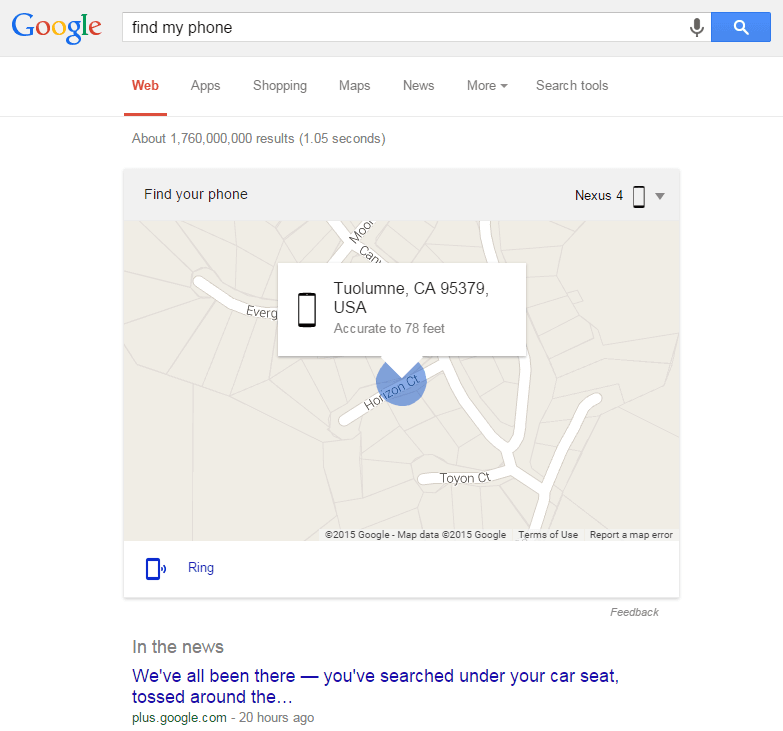
Find my phone

Originally published on webdancers.com

Technology Tagged: android, Google

Owning your words

Owning your words

September 28, 2014 By Greg Falken 2 Comments

There’s a new social media platform called Ello, that’s making a splash for their ad-free policy and their outspoken criticism of their social media brethren. Their manifesto:

Your social network is owned by advertisers.

Every post you share, every friend you make and every link you follow is tracked, recorded and converted into data. Advertisers buy your data so they can show you more ads. You are the product that’s bought and sold.

We believe there is a better way. We believe in audacity. We believe in beauty, simplicity and transparency. We believe that the people who make things and the people who use them should be in partnership.

We believe a social network can be a tool for empowerment. Not a tool to deceive, coerce and manipulate — but a place to connect, create and celebrate life.

You are not a product.

The response has been overwhelming for the invite-only network, with requests in recent days at times exceeding 40,000 per hour.

But I suspect that their no-add policy is only part of the reason why Ello is getting so much attention. Om Malik hit the nail on the head with this Twitter post:

The obsessive coverage of Ello is less about Ello. Instead it really is about our growing dissatisfaction with the state of social networks.

— OM (@om) September 26, 2014

Dave Winer immediately followed up with his Manifesto for Web Writing:

The web of 2014 is in the middle of a huge battle to force people to write the stuff in the same place people read it. Whether you hate advertising or not doesn’t matter, it’s all part of the same system. You make me, as a writer, choose either to give it all to you, or none to you. And yet the underlying network that we use, doesn’t have these limits.

I find it ironic and unsettling that the Internet, a decentralized network where data is distributed without prejudice, has become such a compartmentalized place. When it comes to social networks, we are forced to choose which ones we belong to, based largely on the number of people we know there. We become part of a social network where fraternization with the world outside its walls is discouraged. This negates the very thing that drew me to the Internet in the first place: the ability to communicate with anyone, at any time, because we share a common platform.

My current solution to this dilemma is imperfect. I have a place that I control at gregfalken.com. This is where you can find me and where I share things that I think you might find interesting. From there, I am using IndieWeb principals and projects to distribute my words to other networks that make it possible to do so. For today, that means Facebook, Twitter and LinkedIn. Those of you who know that I’m a Google fanboy will be surprised that Google Plus isn’t on the list. Google, in it’s mysterious wisdom, has decided that Google Plus will not accept input from the outside world. In programmer-speak they have no write API (application programming interface), so anything that I post there has to be done manually.

The best that I can say about this solution is that it’s fairly flexible. As other networks come along they can be added, provided that they offer the inclusiveness of a read/write API. Right now WordPress is my authoring platform of choice but that too can change.

It’s discouraging that it takes so much effort to reach across these social media boundaries. I will continue to explore the options and encourage those of you who are interested to do the same. Please let me know in the comments if you have found any alternatives for broadcasting your own words beyond the single purpose networks.

Technology Tagged: IndieWeb, social media

Fill ‘er up with 2.6 gallons of diesel

Fill ‘er up with 2.6 gallons of diesel

September 22, 2014 By Greg Falken 1 Comment

 Volkswagon XL1

The Volkswagon XL1 in New York traffic

There is now a production automobile that gets 235 miles per gallon. The Volkswagon XL1 is a two-seat, diesel-electric hybrid that is now on sale in Europe. Of course, they’re only making 250 of them, with a sticker price of $150,000 but I think the concept has now been proven. And according to the Rocky Mountain Institute, who contributed this excellent article on Medium, 235 mpg is actually overkill, when it comes to fuel efficiency.

Equally surprisingly, the XL1 may actually take efficiency further than needed. RMI senior associate Jonathan Walker explains: “VW had a different goal than we do. Their goal was to make a 235-mpg car. In my opinion, you don’t need that,” he says. “RMI’s goal is get off carbon and oil. A 100 mpg car gets you there.” RMI’s Reinventing Fire analysis, he notes, can fuel its efficient vehicles, some at just half XL1’s efficiency, with any mixture of electricity, hydrogen, and advanced biofuels but no oil. “The added capital and cost of going for XL1 levels of efficiency is not worth it,” Walker says. “You start getting diminishing returns.” In other words, more modest but still radically improved fuel efficiency can yield an affordable Hypercar that doesn’t carry an XL1 price tag.

The possibilities for meaningful fuel efficiency are exciting but not yet available to regular folks. Eventually though, manufacturers will develop vehicles that save more than they cost. It can’t happen soon enough.

Photos copyright Volkswagon of America.

Technology Tagged: automobile, energy

WiFi Performance Boost

WiFi Performance Boost

August 30, 2014 By Greg Falken 5 Comments

It’s been a while since my last real tech post and if you don’t want to geek out, it’s OK if you skip this one.

I just replaced an aging Netgear wireless router that was being used as an access point (AP), with a Ubiquiti Networks UniFi AP. What a difference! Great signal strength throughout the house and I’m seeing the same throughput on wireless devices as those connected via Ethernet cable. And best of all, no Netflix buffering on our Chromecast connected TV.

UniFi Controller Software

UniFi Controller Software

Ubiquiti makes enterprise grade networking components at a much lower cost than a company like Cisco (the UniFi AP is under $70 from Amazon). Instead of the typical flat box sprouting antennas, the UniFi looks like a smoke detector and is designed to be mounted on a wall or ceiling. It has a single, ring shaped light (which can be turned off) that indicates its status. Unlike most consumer networking hardware, there is no configuration software on the device itself. Instead, all management is done from an application running on a computer, which must be connected to the same network. This allows for configuration and monitoring of multiple APs that can be incorporated into a single wireless network. There was a bit of a learning curve to getting the UniFi Controller software running (hint: make sure that it’s not being blocked by Windows Firewall) but once loaded, it was easy to configure the device.

With the signal coverage that I’m seeing, we have no need for more than one access point. Yet I don’t think that this class of equipment is overkill for a typical household. Last night, we had eight connected devices and my son’s computer had downloaded 1.3GB in the first hour that the UniFi was connected. This kind of demand makes it worth spending a little extra on equipment that was designed to handle much greater loads.

I should note that the UniFi AP does not include a router. It simply connects to the router installed by your ISP to greatly improve wireless connectivity. It also requires an Ethernet cable connection to the router, through which it gets power, using an included Power Over Ethernet injector.

I will keep Ubiquiti on my list of go-to hardware providers.

Technology Tagged: networking, wifi, wireless

POSSE Tools In WordPress

POSSE Tools In WordPress

April 21, 2014 By Greg Falken 5 Comments

Since starting my experiment with IndieWebCamp and POSSE (Publish (on your) Own Site, Syndicate Elsewhere), I’ve learned quite a lot about syndicating content from my own website out to Facebook and Twitter and receiving comments back from those services. I thought it would be helpful to share some of this information and the tools that make it possible. [Read more…]

Technology Tagged: IndieWeb, posse, WordPress

Next Page »

Stay in touch

Sign up to receive occasional email updates, including new blog posts.

As a web developer since 1995, I find my attention increasingly drawn to the intersection of computers, the Internet, communication and education. On this blog, I indulge my interest in these and several other topics. I hope you find them interesting too. Read More…

  • LinkedIn
  • RSS
  • Twitter
  • YouTube

Recent Posts

3 Words for 2021

January 1, 2021 by Greg Falken Leave a Comment

The message we should be hearing about masks: An aviation parable

October 24, 2020 by Greg Falken Leave a Comment

3 Words for 2020

January 1, 2020 by Greg Falken Leave a Comment

3 Words for 2019

January 1, 2019 by Greg Falken Leave a Comment

3 Words for 2018

January 1, 2018 by Greg Falken Leave a Comment

Latest Tweets

  • Just now
  • More on Twitter

Search

Tag Cloud

3 Words Aardvark audio bluetooth Chris Brogan Chrome computer contract Crazy Ivan education FCC flying Google google nexus home hyperlocal IndieWeb learning mobile mp3 music mvno net neutrality Network Sierra paleo phone politics posse primal programming QR code Rick Foster Sharon Crost sim skellie social media sonora Strawberry three words Tom Maguire Tuolumne twitter video WordPress writing

Return to top of page
Copyright © 2009–2026 · Website by Webdancers · Log in