
• Home
  • About
  • Webdancers
  • Contact

GregFalken.com

Thoughts on humanizing technology

  • Technology
  • At Home
  • Music and the Arts
  • Education
  • Notes

Google for Business Class in Sonora

May 29, 2014 By Greg Falken Leave a Comment

Google globeI will be teaching a free Google for Business Class in Sonora on June 11, 2014 from 3-6 pm. The goal of this class is to familiarize business owners with the capabilities of the Google platform, in order to make informed choices about using Google services in their own business. While the class is designed to include people who have not used Google services before, prerequisites include: basic computer use, familiarity with a modern web browser and basic knowledge of the Internet. Some topics covered include:

  • New Google search technologies
  • Google Maps and local search
  • AdWords and AdWords Express
  • Principles of search engine optimization
  • Google Plus, including Hangouts and Communities
  • Google Apps, including Gmail, Calendar and Drive.

This class is sponsored by the Alliance Small Business Development Center. Space is limited, so please register to reserve a seat.

Notes Tagged: education, Google

Congratulations, Jacob

Congratulations, Jacob

May 23, 2014 By Greg Falken 23 Comments

My son, Jacob, graduated from 8th grade yesterday. In my day, the transition from Middle School (then called Junior High) to High School was important but didn’t merit a formal ceremony. More things are celebrated now, which is probably a good thing. For Jacob, it’s a great time to recognize his success at finding a mode of learning that works for him. He has never been a classroom learner and during his early school years developed an intense dislike of schools and teachers. This brought his formal learning nearly to a halt. As parents, we struggled with many questions: Were we being too permissive? Was the problem with his teachers? Could the underlying problem be physical, mental or emotional? We may never find the answers to these questions but over time, we have banged together something that works.

Two years ago, Jacob started attending The Education Option, associated with Gold Rush Charter School in Sonora. With the support of his teacher, Charis Caughey, he transitioned to Acellus, an online curriculum. This allows him to work at his own pace (which is surprisingly fast), outside of the classroom. He now works at or above grade level in all subjects except math (he takes after me in that area).

Jacob graduated with a mention for academic excellence (maintaining at or above a 3.5 GPA) and with four certificates from The Education Option, including having the highest reading score above his grade level (12.5) in STAR testing.

I have long believed that traditional classrooms do a poor job of preparing kids for the world in which we now live. There must be better ways of gaining the knowledge needed to reach goals. We are in a time of transition and it can be scary to depart from a well worn path. My hope for my son is that he continues to find new ways to move through life with purpose and as himself. Well done, Jacob.

At Home Tagged: education, learning

Teaching Digital Literacy

November 16, 2009 By Greg Falken 1 Comment

Digital Literacy

The Scottish Executive, in 2001, defined adult literacy as, “The ability to read and write and use numeracy to handle information, to express ideas and opinions, to make decisions and solve problems, as family members, workers, citizens and lifelong learners.”

Pete Ashton writes on his blog ASH-10:

Digital literacy means being able to take digital stuff [and] make new things with it, just as literacy means taking words and making new sentences with them. Literacy is about understanding the rules of a thing so that they can be worked within or broken as applicable. It’s about making the world our own. This is why we teach reading and writing to children, not so that they can fill out forms or write tedious reports, but that they might question and understand the world in which they live in.

So, what should people know in order to be digitally literate? If we’re going to teach it like a class, what is the curriculum? Most importantly, how can we move away from rote learning of “computer skills” towards understanding the “rules of the thing”.

There are no courses like this in my local community college catalog but here are a few I’d like to see:

Web Browsers – History and Development

For many people, the World Wide Web and the Internet are synonymous. The web browser is the software through which we experience the web. In this course, we will learn the purpose of the web browser and its function in the online experience. We will also explore its history, from the early days of Mosaic (the first Internet-connected software to display images inline with text), through the rise of Internet Explorer and Netscape, to today’s modern Firefox and Chrome browsers.

Cloud Computing and the Rise of Online Applications

Traditionally, software applications and the data they produce have been stored on computers under our desk, on our lap or in the server closet down the hall. This arrangement provided us with quick and easy access to our own data and the illusion of greater control over the applications themselves. With the rise of ubiquitous Internet access both at home and in the workplace, the availability of applications that are accessed online (“in the cloud”) has skyrocketed. From communications and collaboration tools like Google’s suite of programs, to graphic production, accounting and games, nearly any application you can buy in a box can also be found online. In this course, we will examine the potentials and pitfalls of cloud computing, including:
  • Security
  • Reliability
  • Collaboration
  • Costs
  • Data portability
  • Future trends

And once the programs have moved to the cloud, why not move the computers there too? Cloud computing also encompasses the outsourcing of hardware, eliminating the need for a closet full of servers.

The Hyperlink

Hyperlinks subvert hierarchies – David Weinberger

The term hyperlink was coined in 1965 by Ted Nelson, the founder of Project Xanadu, at Harvard University. Nelson hoped to facilitate non-sequential writing, in which the reader could choose their own path through a document. Project Xanadu was largely abandoned by 1989, when the English physicist Sir Tim Berners-Lee wrote a proposal for what would become the World Wide Web, a system of interlinked pages, housed on the Internet and navigated using hyperlinks.

The hyperlink is a radically different way of connecting people to information. In this course, we examine the effects of organizing information in a non-hierarchical system.

Evaluating Online Information

True or false?

SECURITY ALERT: $32,000 worth of UPS uniforms have been purchased over the last 30 days by person(s) unknown. Law enforcement is working on the case however no suspect(s) have been indentified (sic). Subjects may try to gain access by wearing one of these uniforms. If anyone has suspicions about a UPS delivery (i.e., no truck but driver, no UPS identification, etc., contact UPS to verify employment).

Assessing the accuracy of information found online is not always easy. This course draws on the journalistic tradition of verifying sources and establishing their trustworthiness. By considering factors such as verifiability, transparency, relevance, bias, clarity and validity, we can evaluate which online sources to believe and which to ignore.

Online Writing

It seems like everyone online suffers from ADOBSO (Attention Deficit Ooh…Bright Shiny Object), so how do we write in a way that captures their interest? This course looks at online comprehension studies to find effective writing styles. We will also practice writing for various online venues including blogs, web pages, Wikipedia, forums, emails and Twitter.

Syndication and Federation

Release your content into the wild using syndication. Share functionality with other online services using federation. This course examines the current state of machine-to-machine communication on the Internet and how users and site operators can leverage these connections. Technologies covered include RSS, oAuth, Facebook Connect, Friend Connect and Google Wave.

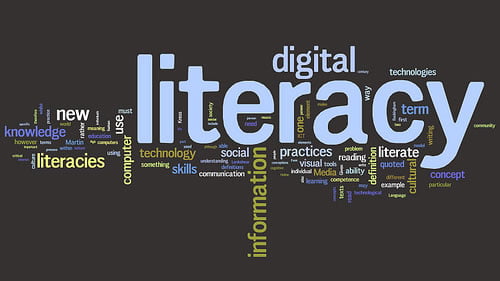
Wordle by Doug Belshaw.

Education, Technology Tagged: browser, cloud computing, education, hyperlink, literacy

Stay in touch

Sign up to receive occasional email updates, including new blog posts.

As a web developer since 1995, I find my attention increasingly drawn to the intersection of computers, the Internet, communication and education. On this blog, I indulge my interest in these and several other topics. I hope you find them interesting too. Read More…

  • LinkedIn
  • RSS
  • Twitter
  • YouTube

Recent Posts

3 Words for 2021

January 1, 2021 by Greg Falken Leave a Comment

The message we should be hearing about masks: An aviation parable

October 24, 2020 by Greg Falken Leave a Comment

3 Words for 2020

January 1, 2020 by Greg Falken Leave a Comment

3 Words for 2019

January 1, 2019 by Greg Falken Leave a Comment

3 Words for 2018

January 1, 2018 by Greg Falken Leave a Comment

Latest Tweets

  • Just now
  • More on Twitter

Search

Tag Cloud

3 Words Aardvark audio bluetooth Chris Brogan Chrome computer contract Crazy Ivan education FCC flying Google google nexus home hyperlocal IndieWeb learning mobile mp3 music mvno net neutrality Network Sierra paleo phone politics posse primal programming QR code Rick Foster Sharon Crost sim skellie social media sonora Strawberry three words Tom Maguire Tuolumne twitter video WordPress writing

Return to top of page
Copyright © 2009–2026 · Website by Webdancers · Log in