
• Home
  • About
  • Webdancers
  • Contact

GregFalken.com

Thoughts on humanizing technology

  • Technology
  • At Home
  • Music and the Arts
  • Education
  • Notes

Readability will change the way you read online

June 16, 2010 By Greg Falken 1 Comment

ReadabilityTechnology consultancy Arc90 has released a simple tool that will work in any modern web browser and makes reading online a whole new experience. The tool is called Readability and it performs a simple task, removing the clutter from almost any web page, leaving only the featured content. The resulting page is cleanly formatted and easy to read. You even get to choose the fonts, margin spacing and general layout. For example:
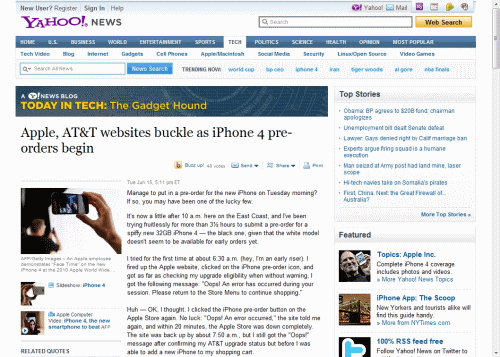
Page before Readability
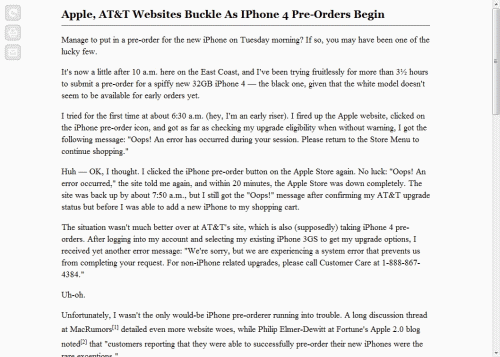
Readability

Page after Readability

Readability is extremely easy to install and use. Follow the steps on their installation page (watch the video first, if you like) to place their bookmarklet on your browser’s toolbar. Then, whenever you’re on a page that you want to really read – not just skim – click the bookmarklet and Readability de-clutters the page. It can even remove the distraction of inline text links, by moving them all to footnotes at the bottom of the content. When you’re done, click the “Reload Original Page” button and the page is restored to its original state.

The developer of Readability, Richard Ziade, was interviewed recently on Rebooting the News, where he explained that developing the technology to correctly identify the featured content on a page and remove everything else was much more difficult than it looks. He started the project in his spare time to meet his own need to reduce the level of distraction that he knew was interfering with his online reading comprehension. The whole program is well worth listening to.

http://mp3.morningcoffeenotes.com/reboot10Jun14.mp3

Our special guest is the developer of the Readability plug-in, Richard Ziade. He’s a partner in arc90, a strategic consulting and software development firm. Recently, his product was in the news because Apple’s Safari browser incorporated it, as Dave explained in a post at scripting.com. (It would be a good idea to read that post before listening.)

It’s a great tool and I’ve been using it a lot but here’s a question that needs to be asked of readers: If you get to control the viewing experience and choose to ignore the ads and other bumpf (and who wouldn’t?), what responsibility do you have to replace the revenue that those ads bring in for the publisher? And conversely, if the readers are voting with their feet and turning off the ads, how can publishers change their content and revenue models, in order to attract readers who are willing to support them? These are questions that all media companies have been grappling with and programs like Readability (and the new Safari 5 browser, which has similar functionality built in) simply shines a brighter light on how our online consumption has changed the media landscape.

Technology Tagged: mp3, Rebooting the News, Richard Ziade

Heroes of American Storytelling

October 19, 2009 By Greg Falken Leave a Comment

This American LifeThey should give these guys an award. Oh yeah, they have: three Peabodys, the George Polk Award, the Edward R. Murrow Award, two Emmys (for their TV show) and many others. This American Life, from WBEZ Chicago, is a weekly radio show that has mastered the art of storytelling. The stories they tell are drawn from every facet of life, from the absurd to the enchanting to the terrifying. Having been at it since 1995, they are amazingly good at what they do.

So it should come as no surprise that when TAL produces shows on two of the dominant issues of our day — the economy and health care reform — listeners are able to grasp the concepts behind these difficult subjects, often for the first time. I am providing links to these shows (play them right from this page or download them for later) because I believe that if more people heard these stories, we would be having a much different conversation about these two critical issues. Also as an example of what storytellers, particularly those in new media, can aspire to.

The Economy

The Giant Pool of Money

https://www.gregfalken.com/wp-content/uploads/2009/10/TAL_Giant_Pool_Of_Money_355.mp3

A special program about the housing crisis produced in a special collaboration with NPR News. We explain it all to you. What does the housing crisis have to do with the turmoil on Wall Street? Why did banks make half-million dollar loans to people without jobs or income? And why is everyone talking so much about the 1930s? It all comes back to the Giant Pool of Money. [Aired 5/9/08]

Return to The Giant Pool of Money

https://www.gregfalken.com/wp-content/uploads/2009/10/TAL_Return_To_Giant_Pool_Of_Money_390.mp3

In which we mark the anniversary of the economic collapse and the anniversary of Planet Money: recapping some of the original episode, The Giant Pool of Money, and finding out what’s happened to all those guys in the year since. [Aired 9/25/09]

Health Care

More Is Less

https://www.gregfalken.com/wp-content/uploads/2009/10/TAL_More_Is_Less_391.mp3

An hour explaining the American health care system, specifically, why it is that costs keep rising. One story looks at the doctors, one at the patients and one at the insurance industry. [Aired 10/9/09]

Someone Else’s Money

https://www.gregfalken.com/wp-content/uploads/2009/10/TAL_Someone_Elses_Money_293.mp3

This week, we bring you a deeper look inside the health insurance industry. The dark side of prescription drug coupons. A story about Pet Health Insurance, which is in its infancy, and how it is changing human behaviors—for example, if you have the pet health insurance, you bring your pet to the vet more often, and the vet makes more money and…well, you can see the parallels. And insurance company jargon, frighteningly decoded. [Aired 10/16/09]

Keep the Stories Coming

If, after listening to these programs, you agree with me about the incredible informational and entertainment value of This American Life, please support them by making a donation.

Show descriptions courtesy of This American Life.

TAL_Giant_Pool_Of_Money_355.mp3

Technology Tagged: economy, health care, mp3, This American Life

Strike Up the Band

October 12, 2009 By Greg Falken 2 Comments

Jacob and the Baritone Horn

My son, Jacob, attends Sierra Waldorf School, in Jamestown, CA. Music has been a part of his curriculum since first grade. They started on wooden pentatonic flutes (watch Bobby McFarrin demonstrate the power of the pentatonic scale), then moved on to the C scale flute and recorder.

This year, in 5th grade, they started band. At their first class, band teacher Mic Harper (a volunteer – go Mic!) picked out which instruments would make up the 5th grade band and then sat down with the kids to decide who would play what. Jacob, of course, picked one that none of us had ever heard of. He called me that afternoon, very excited. “I’m going to play the baritone”, he told me. “That’s great”, I said. “Baritone what?”

Turns out that the baritone horn (known in the band world simply as the baritone) has been a staple in American brass bands for more than a century. Smaller than a tuba, it is easily confused with the euphonium (I’ll never make that mistake again). There is a 3/4 size version for first time students but Mic felt that Jacob could handle the full size instrument. She even found one that he could borrow for the rest of the school year!

It was only last week that the entire class had their instruments and lessons could begin in earnest. The baritone has a mellow sound, which Jacob has put to good use playing the three notes he has learned so far. As his regular teacher said, the classroom sounds like a flock of happy geese during band lesson.

Jacob has been around music all his life. I’ve always tried to impress on him that music is made by people, not by the stereo or the radio. I hope that though his musical education, he will feel a connection with other musicians as speakers of a common language.

To hear a solo performance, click the player below.

https://www.gregfalken.com/wp-content/uploads/2009/10/hot_cross_buns.mp3

Music and the Arts Tagged: Jacob, mp3, Waldorf

Into the Flow We Go

September 22, 2009 By Greg Falken 8 Comments

Flowing Stream

This blog is rssCloud enabled. How would you know? You probably won’t. Should you care? Probably not today. Why did I bother? Well, you know that I like buttons-that-light-up. But seriously, there will be a benefit, as rssCloud and other real time web technologies pick up steam.

A definition: Use of the <cloud> tag — which has been an unused part of the RSS specification since 2001 — allows feed readers and aggregators (like Google Reader, although they don’t yet support rssCloud) to receive nearly instant notification when the feed is updated. Currently, it can take anywhere from a few minutes to a few hours. So, if you were following this blog using an enabled feed reader (and there are very few of them today), you would get new material within seconds of me clicking the Publish button. For most people, their immediate response to this exciting new prospect is, “um…so?”

But there’s more at play here than first meets the eye. Here’s what Dave Winer, the father of RSS, has to say about the use of rssCloud by people like you and me:

The idea is to deliver news faster, without relying on a single company to do all the work.

Until now you could have one or the other, but not both.

You could have the news delivered via RSS, but if you wanted it fast you had to go to Twitter or Facebook or FriendFeed.

The problem with going to a company is two-fold: 1. The company might not be able to handle it. 2. The company might screw with it.

The important idea here is that this method of delivering information is decentralized and beyond the control of a single company, just like the Internet itself. To learn more, take a listen to this Rebooting the News podcast. The first half of the show is Q&A about rssCloud.

http://mp3.morningcoffeenotes.com/reboot09Sep14.mp3

Why real time?

It’s perfectly reasonable to be wondering if we should really be trying to speed up the flow of information. Don’t we already have too much coming at us too fast? However, it appears that the real time web is more than just faster communication, it’s a different form of communication. Writing in ReadWriteWeb, Ken Fromm says:

As with other recent waves of innovation (Web 2.0 and cloud computing, for example) there is no single definition of what the term “real-time Web” means. As a result, it is used as a catch-all phrase for a number of developments underway. At this point, we can identify that the real-time Web…

  1. is a new form of communication,
  2. creates a new body of content,
  3. is real time,
  4. is public and has an explicit social graph associated with it,
  5. carries an implicit model of federation.

…Another characteristic of the real-time Web is that it gives the world a new body of content, one that, unlike IM or email’s, is largely public. Plus the underlying APIs allow third parties to make use of the data through programs, thus extending the reach of the content.

The real time web may have the most impact on what we now call news reporting. With the public growing increasingly dissatisfied with traditional news outlets (as evidenced by their frightening decline in revenue), new sources of information are springing up online. Instead of being spoken down to by the mass media, who decide which stories are worthy of our attention, we can speak “across” to one another about anything that catches our interest. Some people will naturally do this better than others and they will gain a following.

Once we have this raging stream of information, we will need better tools for managing and making sense of it all. Those tools are in the future but, I suspect, not the far distant future. RssCloud (and pubsubhubbub, a related technology) are starting to work at a low level to direct the stream in such a way that we can all dip into it. I think we’ll be using it sooner, rather than later, which is why this blog is rssCloud enabled.

Streaming waters photo by Mikael Miettinen

Technology Tagged: Dave Winer, mp3, podcast, pubsubhubbub, real time web, rssCloud

Stay in touch

Sign up to receive occasional email updates, including new blog posts.

As a web developer since 1995, I find my attention increasingly drawn to the intersection of computers, the Internet, communication and education. On this blog, I indulge my interest in these and several other topics. I hope you find them interesting too. Read More…

  • LinkedIn
  • RSS
  • Twitter
  • YouTube

Recent Posts

3 Words for 2021

January 1, 2021 by Greg Falken Leave a Comment

The message we should be hearing about masks: An aviation parable

October 24, 2020 by Greg Falken Leave a Comment

3 Words for 2020

January 1, 2020 by Greg Falken Leave a Comment

3 Words for 2019

January 1, 2019 by Greg Falken Leave a Comment

3 Words for 2018

January 1, 2018 by Greg Falken Leave a Comment

Latest Tweets

  • Just now
  • More on Twitter

Search

Tag Cloud

3 Words Aardvark audio bluetooth Chris Brogan Chrome computer contract Crazy Ivan education FCC flying Google google nexus home hyperlocal IndieWeb learning mobile mp3 music mvno net neutrality Network Sierra paleo phone politics posse primal programming QR code Rick Foster Sharon Crost sim skellie social media sonora Strawberry three words Tom Maguire Tuolumne twitter video WordPress writing

Return to top of page
Copyright © 2009–2026 · Website by Webdancers · Log in