
• Home
  • About
  • Webdancers
  • Contact

GregFalken.com

Thoughts on humanizing technology

  • Technology
  • At Home
  • Music and the Arts
  • Education
  • Notes

Does Social Media ROI Matter?

October 5, 2009 By Greg Falken 2 Comments

ROI Doodle [Note for the acronym challenged: ROI = return on investment.]

Last week I attended a small business seminar hosted by the Tuolumne County Chamber of Commerce, Sonora Chamber of Commerce, and the Tuolumne County Economic Development Authority, on the subject of online and offline marketing. The offline portion, presented by Bruce Tepper, of SCORE was good, basic advice on marketing and PR for small businesses. Lots of head nodding in the audience accompanied his talk. The online segment, presented by Michelle Shelton, of Luminosity Tech Training and Consulting, raised a lot more questions than it answered.

I should point out that Tuolumne County is not (how shall I put this?) a hotbed of technology. The concepts behind many online strategies, including social media, are new to most business owners. The questions in the room indicate to me that there is a huge educational effort that needs to take place if social media is going to become widespread and effectively used in Tuolumne County.

My friend and colleague Bob Gelman, of BGA Media is more skeptical than I am about the value proposition of social media in general and for small business in particular. He writes in his blog:

After all this, in all my experience, I’m afraid that the Social Media Emperor has no clothes!  That’s because I’ve seen no reason to believe that it will actually be worth the effort that it takes to do this stuff properly.

You would expect me to be an evangelist of this work. I’ve not only worked in this field since 1992, I’ve built several social networks (with my team).  But no, I’m not an evangelist, I’m a skeptic. Having seen the bubble of Internet vapor burst in early 2001, I feel strongly this may be happening again, only this time, the losers could be struggling small businesses who invest their time and energy unwisely.

What a small business needs from its efforts, be they online or off, is ROI. If you have 12 hours in a day to run your business, you probably do not have time to setup Facebook fan pages, write blog articles, tweet on Twitter, and still sell. manufacture, ship, and keep the books as most small businesses do.  So before you tell me to go Yelp, or contribute to the public works Wiki, or check my comments and trackbacks, you’d better be prepared to tell me what it will be worth to me in additional sales and more importantly: profit!

Being the Kumbaya Blogger that I am, I believe that the point of social media is to improve your connection with your market. I suspect that trying to measure the ROI of this is difficult at best and is more than likely an exercise in futility. Everyone acknowledges that word of mouth is an excellent way to build business, yet I don’t know how you would measure its ROI. Social media is word of mouth on steroids.

A few basic concepts that I would like to introduce to our business community:

  • Social media should be used for listening, as well as talking.
  • Social media is a great tool for offering help and service. Not so good for selling stuff.
  • Social media should be part of an overall marketing strategy, which includes goals.
  • Many existing forms of advertising are dying. Social media may be what replaces some of them.
  • Markets are conversations.

We need to lay some groundwork before jumping in to the mechanics of setting up a Facebook fan page or a Twitter client. That’s what I’d like to see brought to the businesses of Tuolumne County. The folks who run these businesses already know the value of connecting with their customers. Many of them don’t have the disadvantage of being under layers of bureaucracy or having to get approval from a home office before trying something new.

Yes, social media takes time and effort; something that small business owners have in short supply. But it’s also nearly free to try it out. Rural communities like ours need to learn about conducting business online and they need to do it now! It’s really just a matter of applying business concepts that they already know (treat your customers right, give them more service than they expect, talk to them like intelligent human beings) to a new form of communication. The act of learning how to use these new tools will have no measurable ROI but I believe that it will pay long term dividends.

ROI doodle by Russell Davies
Technology Tagged: Bob Gelman, marketing, Michelle Shelton, roi, Tuolumne

Find the Need

October 1, 2009 By Greg Falken Leave a Comment


To paraphrase George Bernard Shaw, web developers and their clients are often people separated by a common language. I was recently working on an initial site design with a client who asked me to make it more “grounded”. I was initially at a loss and I bit back my first response of, “what color is grounded?” Instead, I kept asking questions and trying to reflect back the answers to make sure that what I had heard was accurate. We didn’t come up with a design at that meeting (although I did come back with one later that she liked much better) but what emerged was the client’s very strong need to see herself well represented by her web site. This is a perfectly reasonable request, one which any web developer ignores at his peril.

I have been practicing a technique for some time now called Nonviolent Communication, created by Marshall Rosenberg, Ph.D. His belief is that all people’s feeling and actions are driven by their needs, either met or unmet, and that those needs are universal. They include trust, safety, respect, integrity, understanding, being understood, and many more. When we empathize with and express an understanding of the needs of other people, it will often get us past barriers to communication, such as I experienced with the color of “grounded”.

Extending this theory into the online world, when people visit web sites, blogs or social networks, they do so in an attempt to meet needs. The better we are at anticipating those needs, the more likely we are to facilitate meeting them. And if we can do that, we become heroes. At just about any stage in the development process, it’s worth asking the question, “what need are we trying to meet here?” Some needs that might be met at various stages of an online experience could be clarity, comfort, security, fun, trust, contribution, connection, etc. Meeting these needs becomes a high-level goal in the development process and can guide decisions made about implementing specific features. If a feature doesn’t contribute to meeting a need, it’s probably unnecessary.

Focusing on needs can bypass a lot of the imprecision that comes with people describing what they “want”. Clients often come to us with a  very detailed description of what they want a particular function to do. In these cases, it’s important to find out what need (or goal, if you like) will be met if this function works in exactly the way they expect it to. What we usually find is that there is some more effective technical means of meeting the need than the one they have described. By cutting straight through to the need, we can streamline the process, allowing each of us to do what we do best; the client focusing on their business strategies and the developers coming up with the means of achieving them based on the technology at hand.

Understanding the needs of the users of a site also requires empathy. First, in assessing which need you are trying to meet and then again in trying to gauge the users’s response to the strategies you have employed. For example, in designing an e-commerce checkout system, there is a need for clarity (the user must know what information is required and what their options are), security (they must feel that financial information is safe) and trust (they must believe that you will deliver the goods that they have purchased). If any of these needs are not met, they are quite likely to feel frustrated, concerned or angry, making it far less likely that they will actually complete a purchase.

Of course, simply identifying needs is not enough to produce a great online experience. There is still the need for planning, design and execution. But striving to meet the needs of everyone involved (including the developers!) must remain in the forefront during the development process and, indeed, throughout the life cycle of the project. They are a touchstone to return to often, when things are working well and especially when they are not.

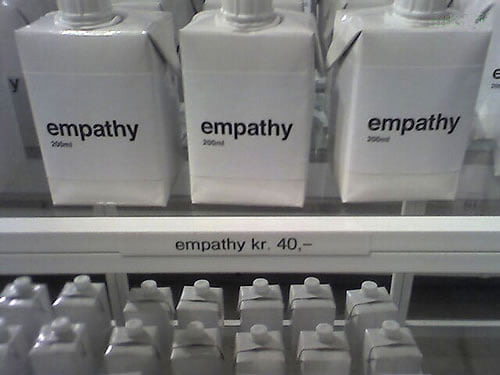
Empathy photo by Geoff Jones.

Technology Tagged: development, empathy, Marshall Rosenberg, needs, Nonviolent Communication

Into the Flow We Go

September 22, 2009 By Greg Falken 8 Comments

Flowing Stream

This blog is rssCloud enabled. How would you know? You probably won’t. Should you care? Probably not today. Why did I bother? Well, you know that I like buttons-that-light-up. But seriously, there will be a benefit, as rssCloud and other real time web technologies pick up steam.

A definition: Use of the <cloud> tag — which has been an unused part of the RSS specification since 2001 — allows feed readers and aggregators (like Google Reader, although they don’t yet support rssCloud) to receive nearly instant notification when the feed is updated. Currently, it can take anywhere from a few minutes to a few hours. So, if you were following this blog using an enabled feed reader (and there are very few of them today), you would get new material within seconds of me clicking the Publish button. For most people, their immediate response to this exciting new prospect is, “um…so?”

But there’s more at play here than first meets the eye. Here’s what Dave Winer, the father of RSS, has to say about the use of rssCloud by people like you and me:

The idea is to deliver news faster, without relying on a single company to do all the work.

Until now you could have one or the other, but not both.

You could have the news delivered via RSS, but if you wanted it fast you had to go to Twitter or Facebook or FriendFeed.

The problem with going to a company is two-fold: 1. The company might not be able to handle it. 2. The company might screw with it.

The important idea here is that this method of delivering information is decentralized and beyond the control of a single company, just like the Internet itself. To learn more, take a listen to this Rebooting the News podcast. The first half of the show is Q&A about rssCloud.

http://mp3.morningcoffeenotes.com/reboot09Sep14.mp3

Why real time?

It’s perfectly reasonable to be wondering if we should really be trying to speed up the flow of information. Don’t we already have too much coming at us too fast? However, it appears that the real time web is more than just faster communication, it’s a different form of communication. Writing in ReadWriteWeb, Ken Fromm says:

As with other recent waves of innovation (Web 2.0 and cloud computing, for example) there is no single definition of what the term “real-time Web” means. As a result, it is used as a catch-all phrase for a number of developments underway. At this point, we can identify that the real-time Web…

  1. is a new form of communication,
  2. creates a new body of content,
  3. is real time,
  4. is public and has an explicit social graph associated with it,
  5. carries an implicit model of federation.

…Another characteristic of the real-time Web is that it gives the world a new body of content, one that, unlike IM or email’s, is largely public. Plus the underlying APIs allow third parties to make use of the data through programs, thus extending the reach of the content.

The real time web may have the most impact on what we now call news reporting. With the public growing increasingly dissatisfied with traditional news outlets (as evidenced by their frightening decline in revenue), new sources of information are springing up online. Instead of being spoken down to by the mass media, who decide which stories are worthy of our attention, we can speak “across” to one another about anything that catches our interest. Some people will naturally do this better than others and they will gain a following.

Once we have this raging stream of information, we will need better tools for managing and making sense of it all. Those tools are in the future but, I suspect, not the far distant future. RssCloud (and pubsubhubbub, a related technology) are starting to work at a low level to direct the stream in such a way that we can all dip into it. I think we’ll be using it sooner, rather than later, which is why this blog is rssCloud enabled.

Streaming waters photo by Mikael Miettinen

Technology Tagged: Dave Winer, mp3, podcast, pubsubhubbub, real time web, rssCloud

FCC Support for Net Neutrality

September 21, 2009 By Greg Falken Leave a Comment

FCC

Net neutrality was in the news quite a bit in 2007-2008.  A neutral network is one that is free of restrictions on content, sites, or platforms, on the kinds of equipment that may be attached, and on the modes of communication allowed.

In what is very good news for the future of open access to the Internet. FCC Chairman Julius Genachowski has posted a statement on Broadband.gov (cross-posted on Whitehouse.gov and Huffington Post) entitled, The Open Internet: Preserving the Freedom to Innovate. In it, he suggests that the role of the FCC is be the “smart cop on the beat” in supporting free and open access to the Internet. To this end, he proposes two new FCC rules:

The first says broadband providers cannot discriminate against particular Internet content or applications. The second says broadband providers must be transparent about their network management practices. These principles would apply to the Internet however it is accessed, though how they apply may differ depending on the access platform or technology used. Of course, network operators will be permitted to implement reasonable network management practices to address issues such as spam, address copyright infringement, and otherwise ensure a safe and secure network for all users.

I also proposed that the FCC formally enshrine the four pre-existing agency policies that say network operators cannot prevent users from accessing the lawful Internet content, applications, and services of their choice, nor can they prohibit users from attaching non-harmful devices to the network.

Chairman Genachowski believes that these rules are necessary to prevent the recurrence of previous abuses:

We’ve already seen some clear examples of deviations from the Internet’s historic openness. We have witnessed certain broadband providers unilaterally block access to VoIP applications and implement technical measures that degrade the performance of peer-to-peer software distributing lawful content. We have even seen one service provider deny users access to political content.

The FCC has also created a new site, Openinternet.gov, as a place to participate in discussions about a free and open Internet. I plan to spend some time checking it out and I hope you will too.

Technology Tagged: FCC, Julius Genachowski, net neutrality

Revival

September 20, 2009 By Greg Falken 3 Comments

Birch Lake

Birch Lake

Sunday mornings at Strawberry Music Festival involves a lot of walking.  First thing after crawling out of my sleeping bag is to hoof it down to Music Meadow to do the “Strawberry Stroll”, during which you stand in line with a couple of hundred fellow Strawberians, waiting to lay out blankets, tarps and chairs for the day.  The gates open at 7 am and by 7:30 we’re all situated and headed back to our camps.

Since it’s Sunday, I’ll grab another blanket and head on down to Birch Lake, for the Revival that starts at 9 am.  Revival is a long-standing tradition at Strawberry and it’s often a challenge for the musicians who enjoyed the “Strawberry Way” late into the evening the night before.  Many bluegrass festivals have a gospel show on Sunday mornings but that doesn’t quite describe the Revival.

Rather than an invocation, we start with a story, often told by Strawberry’s resident storyteller, B.Z. Smith.  Whatever the subject, these stories always provoke a profound sense of gratitude and togetherness among the several hundred souls gathered there on the grass.  And then the music begins.

It’s a different feeling from the main stage at Music Meadow.  Bands that blazed though their sets the night before play with a bit more thoughtfulness (or so I imagine).  And, yes, there are more gospel numbers and they are welcomed.  The paid ticket holders have been here for three days now, the volunteers one or two days more.  Just about everyone is in need of a little revival to make it through the last day of the festival.

The closing act is the Del McCoury Band.  He and his band, including his sons on mandolin and banjo, are dressed in suits and ties, as they are for all their shows.  This year, Del is celebrating his 70th birthday and 50th anniversary playing bluegrass music.  At this announcement, he receives a prolonged standing ovation from a crowd that looks much different from those in his native North Carolina but  who are no less appreciative.

One of the songs performed by Del McCoury that morning is the gospel standard, Get Down On Your Knees and Pray, performed in this video at the Ryman Auditorium in Nashville, in 2002.  I’m here to tell you, Del hasn’t lost a step or a note in the past seven years.  Just imagine yourself listening to those harmonies under the birch trees on a cool September morning in the Sierras.

Music and the Arts Tagged: BZ Smith, Del McCoury, revival, Strawberry, video

« Previous Page
Next Page »

Stay in touch

Sign up to receive occasional email updates, including new blog posts.

As a web developer since 1995, I find my attention increasingly drawn to the intersection of computers, the Internet, communication and education. On this blog, I indulge my interest in these and several other topics. I hope you find them interesting too. Read More…

  • LinkedIn
  • RSS
  • Twitter
  • YouTube

Recent Posts

3 Words for 2021

January 1, 2021 by Greg Falken Leave a Comment

The message we should be hearing about masks: An aviation parable

October 24, 2020 by Greg Falken Leave a Comment

3 Words for 2020

January 1, 2020 by Greg Falken Leave a Comment

3 Words for 2019

January 1, 2019 by Greg Falken Leave a Comment

3 Words for 2018

January 1, 2018 by Greg Falken Leave a Comment

Latest Tweets

  • Just now
  • More on Twitter

Search

Tag Cloud

3 Words Aardvark audio bluetooth Chris Brogan Chrome computer contract Crazy Ivan education FCC flying Google google nexus home hyperlocal IndieWeb learning mobile mp3 music mvno net neutrality Network Sierra paleo phone politics posse primal programming QR code Rick Foster Sharon Crost sim skellie social media sonora Strawberry three words Tom Maguire Tuolumne twitter video WordPress writing

Return to top of page
Copyright © 2009–2026 · Website by Webdancers · Log in