
Here in the Central Sierras, our choice of cellular carriers is, shall we say, limited. In Tuolumne County there are exactly two: AT&T and Golden State Cellular. I have been a Golden State Cellular customer since moving here in 1994 and have generally been very satisfied with their service. Of course, for most of those years I used a “dumb” phone, resisting the smartphone movement for as long as I could. Finally I could ignore it no longer and learned the joys of data plans, 3G and edge networks, tethering and data roaming. Coming up on the end of my second two year contract, I found that I was unwilling to lock in to another two years of the same plan and, especially, the same phone.
The phone that I had been using for the past two years, a Motorola Milestone 2, was on its last legs, which had also been the case at the end of my first contract (at that time with an HTC Hero). I also wanted my next phone to be a Google Nexus, which will not work on Golden State Cellular’s CDMA network. So I began looking at alternatives to the traditional two year cell phone contract. This is what I learned.
No contract, no $99 phone
One of the benefits of the two year contract is that the carrier subsidizes the cost of the phone. I paid nothing up front for my first smartphone and $99 for the second. Of course, this low price is really more like a down payment, as the carrier builds the cost of the phone into the contract. A modern smartphone is expensive and if you’re going to go off-contract, you have to bring your own “unlocked” phone.
An unlocked phone is one that is not sold for use on any one carrier. They are available on Amazon.com and from many other electronics stores. A carrier can also unlock a phone that previously was locked to their network. They will generally only do this once the phone is off-contract.
The mysteries of the MVNO
Every new technology brings its own set of acronyms and early on I discovered the Mobile Virtual Network Operator or MVNO. These companies are resellers of services from the large carriers: AT&T, T-Mobile, Sprint, etc. They buy network services and resell them to consumers on a month-to-month basis, without a contract and usually at a lower price than you would pay as a customer of the original carrier. You will need to pick an MVNO that resells the services of a carrier that has good coverage in your area, which for me means AT&T. There is a comprehensive list of MVNOs and the services they offer at this Wikipedia page. After narrowing down the list by carrier, I went on to comparing plans and reading reviews. I was struck by how many people really hate the customer service provided by MVNOs and it made me think twice about the whole idea. However, some were hated less than others and that further narrowed the field.
Picking a plan
Because I use my phone’s Internet features more than I use it to make calls, I only considered plans including data. This eliminates about half of the plans offered by MVNOs. The next question was, how much data do I need? Looking back over my last few bills, I found that I typically used less than 500MB of data per month. This is because I very rarely stream audio or video. I listen to lots of podcasts but these are downloaded to my phone only when it’s connected to a WiFi network. My over-the-air data usage is mainly for things like sending and receiving email, map data, browsing Facebook and Google+ and uploading the occasional photo. Data plans start at around 250MB per month and top out around 3GB. It appears that the major carriers are stingy about the data bandwidth that they will make available to MNVOs. Most plans that include data also give you unlimited voice and text.
A word about unlimited data: For a time, MVNOs offered “unlimited” data plans that were in fact severely throttled after 1 or 2GB of data had been used. After that, they served data so slowly that it became a de facto cap on data. There was so much customer backlash that these plans have largely disappeared, in favor of plans that clearly state the data cap. If you do hit that limit, you will either have no data at all until the start of the next billing period or you may have the option to add to your data allotment (at a much higher price) for the current period. Just remember, at this time there’s no such thing as an unlimited data plan from an MVNO.
Playing the SIM card
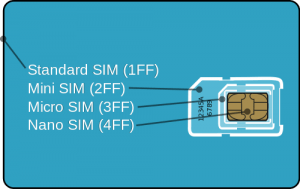
SIM Card Sizes
There are two types of cellular networks in the US: GSM and CDMA. If, like I was, you are on a CDMA network, your phone doesn’t need a SIM (subscriber identification module) card. Instead, this information is programmed into the phone. AT&T and T-Mobile are the only two US carriers using GSM networks and each provides SIM cards for the phones that will connect to them. Each MVNO that resells services on a GSM network also has their own SIMs. The SIM tells the phone which network it will connect to. Some MVNOs give the SIM away for free, most charge a nominal amount ($5-$15) and there is also a thriving secondary market. I ended up getting a SIM on eBay for $.99 (with free shipping). Make sure that you get the right size SIM for your phone; they come in multiple sizes.
The SIM card alone will connect you to your new voice network but it isn’t all you need to make a data connection. You will also need to know the Access Point Name (APN) settings for your MVNO’s network. These are entered into your phone’s settings (in Android, they’re under Settings > More > Mobile Networks > Access Point Names). Depending on how good the help section of your MVNO’s website is, some Googling may be needed to find the right settings for Internet access and MMS. If all else fails, you can call customer service.
Coverage
In order to get the best quality signal for both voice and data, find out which major carrier owns the towers in your area. Don’t rely on peering agreements between carriers when using an MVNO. If you’ll be using AT&T’s towers, get your plan from an AT&T MVNO. There’s some debate about whether the signal quality provided to MVNOs is the same as from the orginal carrier. All I can say is that in my area, the AT&T signal is good – not great – and I hear the same from people who get their service from AT&T directly.
Throwing the switch
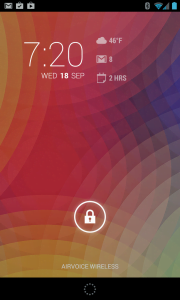
Nexus 4 Lock Screen
My personal tipping point came when Google put the Nexus 4 on sale for $200 in the Play Store (they sold out very quickly). I know that the Nexus 5 is coming soon but this was too good a price to resist. So this is where I ended up:
- Google Nexus 4 8GB from Google Play Store
- AirVoice Wireless micro SIM from eBay vendor – $.99
- AirVoice Wireless plan – 1GB data, unlimited voice and text – $40 per month
- Early termination fee – $150
So far, my experience being unlocked and off-contract has been liberating. I love the Nexus 4 for its screen size and resolution, performance (app switching speed and overall smoothness) and battery life. It will always get the most current version of Android directly from Google, keeping it fresh in the software department. AirVoice too has been a good choice. Coverage isn’t as good as I was getting on Golden State Cellular but I think it will be good enough. I use a Google Voice number, so switching carriers is dead simple, if I decide to change in the future. I’m not feeling any MotoX or Nexus 5 envy. No regrets on making the switch; it’s a great phone and a money saving plan.
Leave a Reply